
Blurred vision is one of those problems that everyone has felt at some point — a fuzzy sign on the road, words swimming on the phone, a face across the room that will not quite sharpen. Sometimes it passes with a blink. Other times it stays, or it comes back a little worse each month. Understanding the blurred vision causes behind that fuzziness helps you decide whether it is a simple glasses fix, a screen-habit problem, or something that actually needs attention today. This guide walks through the common reasons, the serious ones, and the clear signs that tell you to see an eye doctor for blurred vision without waiting.
The most common blurred vision causes
Refractive errors: the glasses number reason
By far the most common cause. If the shape of your eye bends light a bit off-target, the image lands slightly out of focus on the retina. Doctors split this into three types:
- Myopia (short-sightedness) — distant things look blurry, near things stay clear
- Hyperopia (long-sightedness) — near objects blur first, though far objects can blur too
- Astigmatism — both near and far objects look stretched or slightly doubled because the cornea is not perfectly round
After 40, presbyopia joins the list — the natural lens stiffens and small print moves out of reach. All of these are harmless and fixable with the right glasses, contact lenses, or LASIK if you are a candidate. Blurry vision treatment in this case is straightforward: a proper refraction test and a fresh prescription.
Dry eyes and excessive screen use
If your vision blurs after a long stretch on the phone or laptop and clears when you blink hard, dry eyes or digital eye strain are very likely the cause. When you stare at a screen, your blink rate drops and the tear film dries out, leaving a thin, uneven surface over the cornea that scatters light. A blurry vision and headache combination after hours of screen work usually points here. Lubricating drops, the 20-20-20 rule, and conscious blinking clear most cases. If the dryness is persistent, a doctor should check whether there is a deeper tear-film problem.
Cataract
As the natural lens slowly clouds with age, colours fade, glare increases, and the world looks like you are peering through a fogged-up window. Cataract usually builds over months or years, so the blurring creeps in gradually. It is the leading cause of reversible blindness in India and one of the most common blurred vision causes in people over 50. The fix is a quick, stitchless surgery that replaces the cloudy lens with a clear artificial one.
Glaucoma
Glaucoma usually steals side vision first, so you may not notice blurring in the usual sense until a large patch is already gone. However, an acute (sudden) glaucoma attack causes severe blurring, intense eye pain and headache, and a red eye with halos around lights. That is an emergency, and the distinction from a gradual blur matters a lot.
Diabetic retinopathy
High sugar damages the tiny blood vessels in the retina. In early stages, diabetic retinopathy produces no symptoms at all. As it advances, it can cause blurry vision in one eye or both, floaters, and dark patches. If you have diabetes and your vision starts to blur, do not assume it is just a glasses change — get a retina check.
Other causes worth knowing
- Eye infections or corneal ulcers — painful blurring, redness, discharge; common in contact-lens users and after monsoon eye infections
- Migraines — blurry vision and headache with aura, zigzag lights, then a throbbing headache that follows
- Medication side effects — some blood-pressure and anti-allergy drugs can temporarily blur vision
- Pregnancy — hormonal changes can shift the glasses number or cause dry eyes
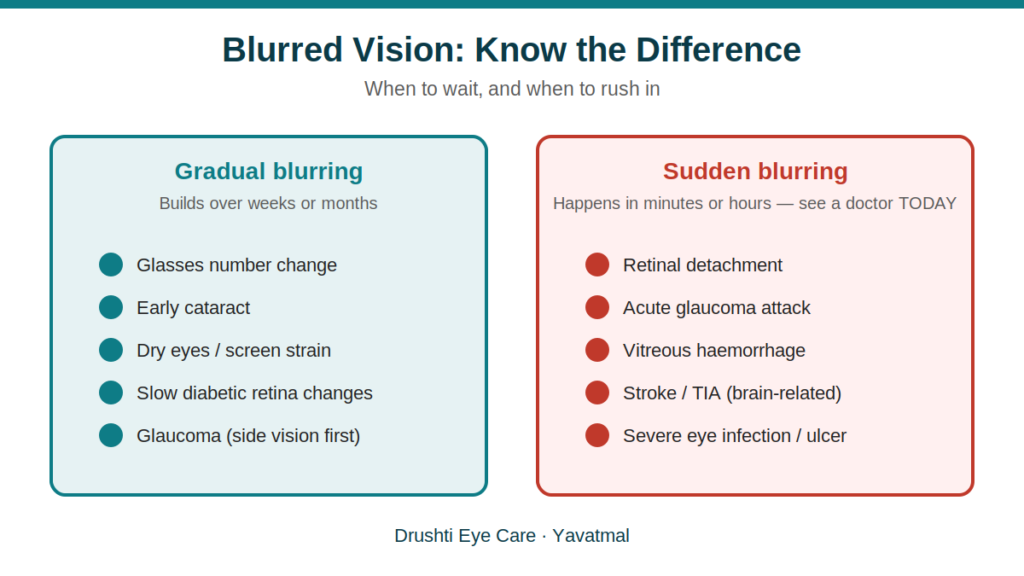
Gradual blurring vs sudden blurred vision: why the speed matters
The single most important question when your vision blurs is how fast it happened. Gradual blurring over weeks or months usually points to a glasses change, early cataract, or slow diabetic changes — all manageable with a routine appointment. Sudden blurred vision that develops in minutes or hours is different. It can signal a retinal detachment, an acute glaucoma attack, a vitreous haemorrhage (bleeding inside the eye), a severe corneal infection, or even a stroke or TIA affecting the brain. The American Academy of Ophthalmology lists sudden vision changes as a reason to seek immediate care.
Emergency warning signs — see a doctor today
Do not wait for a routine appointment if you experience any of these:
- Sudden blurred vision in one or both eyes that does not clear
- A shower of new floaters or flashing lights
- A shadow or curtain coming across part of your vision
- Severe eye pain with blurring and redness
- Blurry vision and headache with nausea, especially with halos around lights
- Vision loss after an injury to the eye or head
- Sudden blurring with weakness, slurred speech, or numbness (possible stroke — call an ambulance)
How your eye doctor finds the cause
An eye examination for blurred vision is not just reading the chart on the wall. At Drushti Eye Care, the check-up includes:
- Refraction test — your exact glasses number, near and far
- Slit-lamp examination — a close look at the cornea, lens, and front of the eye for cataracts, infections or dry-eye signs
- Eye-pressure measurement — to rule out glaucoma
- Dilated retina examination — drops widen the pupil so the doctor can see the retina, optic nerve and blood vessels directly; this catches diabetic changes, macular problems and detachment
- OCT scan — a detailed cross-section image of the retina when needed
- Visual field test — maps your side vision for glaucoma screening
The whole visit takes under an hour, and most of it is painless. The dilating drops blur near vision for a few hours, so plan to have someone help you home.
Blurry vision treatment: what are the options
Treatment depends entirely on the cause, which is why the examination matters more than guessing:
- Refractive errors — updated glasses, contact lenses, or LASIK
- Dry eyes / screen strain — lubricating drops, screen habits, and sometimes prescription dry-eye treatment
- Cataract — phaco surgery with an intraocular lens when the blur affects daily life
- Glaucoma — pressure-lowering drops, laser, or drainage surgery
- Diabetic retinopathy — sugar control, laser, or intravitreal injections
- Infections / ulcers — medicated drops tailored to the cause
If you are searching for blurred vision treatment near me, the key step is seeing a trained eye doctor first, because over-the-counter drops or borrowed glasses can mask a problem that needs real care.
When to book an eye examination
Book a routine visit if blurred vision has been building gradually, if your glasses no longer feel right, or if screen use leaves your eyes tired and blurry. Book an urgent same-day visit if blurring comes on suddenly, if it affects only one eye out of nowhere, or if it arrives with pain, headache, flashes, or floaters. And if you are over 40 or have diabetes, a yearly comprehensive eye check-up is the smartest way to catch blurred vision causes before they become symptoms.
Why families trust Drushti Eye Care
Over the last 15 years we have looked after more than 10,000 patients, with every test listed above available under one roof. Dr. Subodh Purohit leads the care, and families from Yavatmal and nearby towns like Wani, Pusad, Pandharkawda and Darwha come in for everything from a simple glasses check to an emergency retina assessment. Whether the answer turns out to be a half-number glasses correction or something that needs immediate treatment, you leave with a clear diagnosis in one visit.
Blurry vision that will not clear?
Do not guess the cause. Book an eye check and get a clear answer.
Call or WhatsApp: 094229 22429
Drushti Eye Care,State Bank Chowk Rd, in front of Timber Bhavan, Dhamangaon Road, Pangari, Yavatmal, Maharashtra 445001
Frequently asked questions
What are the most common blurred vision causes?
Refractive errors (needing glasses) are the most common. After that, dry eyes, cataract, glaucoma, diabetic retinopathy and screen strain make up the bulk of what we see.
Is sudden blurred vision an emergency?
Yes, especially if it comes on in minutes, affects one eye, or arrives with pain, flashes, floaters or headache. See an eye doctor the same day.
Why is my vision blurry in one eye only?
Blurry vision in one eye can point to a different glasses number in that eye, an early cataract, a retinal problem, or a corneal issue. A check-up pinpoints which it is.
Can blurred vision and headache be related?
Yes. A wrong glasses number, digital eye strain, an acute glaucoma attack, and migraines can all cause both symptoms together. The combination deserves a proper examination.
Where can I find blurred vision treatment near me?
At Drushti Eye Care in Yavatmal, we diagnose the cause in one visit and offer treatment for every condition listed above, from updated glasses to surgery. Families also come in from Wani, Pusad, Pandharkawda and Darwha.
Should I see an eye doctor even if the blur comes and goes?
Yes. Intermittent blurring can mean dry eyes, early diabetes-related changes, or a fluctuating glasses number. Catching the cause early keeps treatment simple.