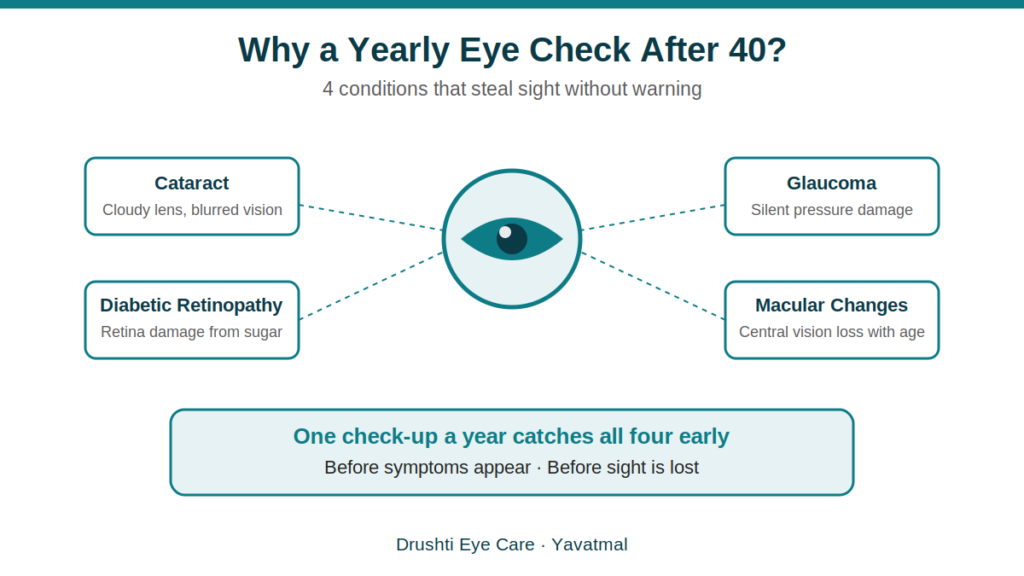
Most people do not think about their eyes until something goes wrong. A yearly eye check-up after 40 changes that completely, because the four biggest sight-threatening conditions all begin in this decade, and every one of them starts silently. No pain, no blurring, no red flag of any kind. By the time you notice a change on your own, the damage has often been building for years. One short visit once a year catches it while the fix is still simple. Here is what actually changes in your eyes after 40, what a thorough check looks for, and why it matters more than most people realise.
What changes in your eyes after 40
Around your early forties, a few things shift. The natural lens inside the eye gradually loses its flexibility, which is why small print and your phone screen get harder to read without holding them further away. This is called presbyopia, and it is completely normal. New reading glasses or a number change fix it easily.
But presbyopia is just the obvious, harmless one. Underneath, more serious changes can begin at the same time without producing any symptoms at all.
The four silent conditions a yearly check catches
1. Cataract
The lens slowly turns cloudy with age. In early stages you might just notice mild glare or colours looking slightly faded, or you might notice nothing at all. A check-up spots the earliest haze long before it bothers you, and modern cataract surgery is quick, stitchless and highly successful when the time comes.
2. Glaucoma
Eye pressure builds up and quietly damages the optic nerve. Glaucoma takes your side vision first, and your brain fills in the gaps so well that you do not notice until a large patch is already gone. A simple, painless pressure test and an optic-nerve check catch it years before you would feel it. Once found, drops or a quick laser procedure keep it under control for life.
3. Diabetic retinopathy
If you have diabetes, high sugar damages the tiny blood vessels in the retina. Diabetic retinopathy causes no symptoms early on; we find it only by looking at the retina directly. Caught early, tight sugar control and, if needed, laser treatment prevent most vision loss. Missed for years, the damage can be permanent.
4. Age-related macular changes
The macula is the small central area of the retina that gives you detailed vision for reading and recognising faces. With age, it can thin or develop deposits. Early macular changes show up on a retina scan before you notice anything wrong. Monitoring means the doctor can act quickly if it worsens.
Notice the pattern: all four begin without pain and without obvious blurring. The only reliable way to catch them is a proper examination by a trained eye doctor. Waiting for a symptom is not a plan — it is a gamble. The National Eye Institute recommends a comprehensive dilated eye exam for everyone over 40.
What a complete eye check-up includes at Drushti
A full examination is not just a glasses test. At Drushti Eye Care, a visit covers:
- Vision and refraction — your exact glasses number, near and far
- Eye-pressure measurement — using a non-contact tonometer (a quick, painless air-puff test)
- Slit-lamp examination — a detailed look at the front of the eye, including the lens for early cataract
- Retina and optic-nerve check — with drops to widen the pupil and, where needed, a digital retina photo or OCT scan
- Visual field test — automated perimetry to map blind spots you cannot feel, the key glaucoma screen
The whole thing takes under an hour. The pupil-dilating drops blur near vision for a few hours, so it helps to bring someone along to drive you home.
Who especially must not skip it
A yearly eye check-up after 40 matters for everyone, but some people carry extra risk and should be stricter about keeping the appointment:
- Anyone with diabetes or high blood pressure
- Anyone whose parent, brother or sister has glaucoma
- People with a high glasses number, especially minus (short-sighted)
- Long-term steroid users
- Farmers and outdoor workers with years of sun and dust exposure
- Anyone who has already had an eye injury or surgery
What about younger eyes?
Forty is the line after which routine annual checks become non-negotiable. But younger eyes are not immune. Students and screen workers dealing with digital eye strain benefit from a check if the tiredness does not ease with habit changes. Parents should bring children in if they notice squinting, head tilts or falling school performance, since lazy eye and squint are treatable only within a window. And anyone considering LASIK for glasses freedom needs a detailed evaluation first. Even during the monsoon season, a quick check helps you tell a simple infection from something that needs real treatment.
The real cost of skipping
A yearly check-up costs a fraction of what treating advanced glaucoma or late-stage diabetic retinopathy costs, in money, in time, and in the sight you cannot get back. People often tell us they did not come because “my eyes felt fine.” That is exactly the problem. Fine-feeling eyes are no guarantee that fine-looking retinas and nerves sit behind them. Five minutes of testing once a year is a small trade for decades of clear sight.
Why families trust Drushti Eye Care
Over the last 15 years we have looked after more than 10,000 patients, with every diagnostic listed above available under one roof and care led by Dr. Subodh Purohit. Families from Yavatmal and nearby towns like Wani, Pusad, Pandharkawda and Darwha come to us for exactly this kind of comprehensive annual check — the one that catches trouble while there is still time to stop it. You can also read about how to choose the right eye hospital for your family.
When was your last eye check?
If it has been more than a year, book one today. It takes under an hour and it could protect your sight for life.
Call or WhatsApp: [Clinic Phone Number]
Drushti Eye Care, [Clinic Address], Yavatmal · Contact us
Frequently asked questions
How often should adults get their eyes checked?
Once a year after 40, even with no symptoms. If you have diabetes, glaucoma in the family, or other risk factors, your doctor may call you back sooner.
What does a complete eye examination include?
At Drushti it covers vision and refraction, eye-pressure measurement, a slit-lamp examination of the front of the eye, a dilated retina and optic-nerve check, and a visual field test where needed.
Is an eye check-up necessary if I see fine?
Yes. The four major conditions that begin after 40 — cataract, glaucoma, diabetic retinopathy and macular changes — all start with no symptoms. Feeling fine is not the same as being fine.
What eye problems start after age 40?
Presbyopia (difficulty reading small print) is the common one. The serious ones are early cataract, glaucoma, diabetic retinopathy and age-related macular changes, all of which begin silently.
How much does a full eye check-up cost in Yavatmal?
A comprehensive check at Drushti Eye Care is affordable and covers every test listed above. Call or visit for the current fee, which we explain upfront with no hidden charges.