Tired of wearing spectacles every day? Wondering whether LASIK, SMILE, or ICL could help you see clearly without depending on glasses or contact lenses?
Whether you struggle with foggy glasses, uncomfortable contact lenses, or difficulty enjoying sports without spectacles, modern vision correction procedures offer several possible solutions.
Three commonly discussed options are LASIK eye surgery, SMILE eye surgery, and ICL surgery.
But which is right for you?
Understanding LASIK vs SMILE vs ICL is an important first step before choosing any vision correction procedure.
Each treatment works differently, and the most suitable option depends on factors such as your spectacle prescription, corneal thickness, eye health, age, and lifestyle.
In this guide, Drushti Eye Care, Yavatmal, explains the key differences, potential benefits, limitations, recovery expectations, and important questions to discuss with your eye specialist.
What Are LASIK, SMILE and ICL?
LASIK, SMILE, and ICL are procedures designed to correct certain refractive errors.
Refractive errors occur when light does not focus properly on the retina, resulting in blurry vision.
Common refractive errors include:
- Myopia (nearsightedness): Distant objects appear blurry.
- Hyperopia (farsightedness): Nearby vision may be affected, although symptoms vary.
- Astigmatism: Vision may appear blurry or distorted at different distances.
While spectacles and contact lenses correct these problems without surgery, refractive procedures aim to reduce dependence on them.
The main difference is how each procedure changes the eye’s focusing power.
LASIK and SMILE reshape the cornea, while ICL involves placing a specially designed lens inside the eye without removing the natural lens.
What Is LASIK Eye Surgery?
LASIK stands for Laser-Assisted In Situ Keratomileusis.
It is a widely used laser vision correction procedure that changes the shape of the cornea to improve how light focuses on the retina.
How does LASIK work?
During LASIK surgery:
- The eye is numbed using anesthetic eye drops.
- A thin flap is created in the cornea.
- A laser reshapes the underlying corneal tissue according to the patient’s refractive error.
- The flap is repositioned without stitches.
LASIK may be used to correct suitable cases of myopia, hyperopia, and astigmatism.
Potential advantages of LASIK
- Established treatment with extensive clinical experience.
- Many suitable patients notice improved vision relatively quickly.
- Can treat several types of refractive errors.
- Usually requires only a short procedure time.
- May significantly reduce dependence on spectacles or contact lenses.
Limitations of LASIK
LASIK is not appropriate for everyone.
Patients with very thin or irregular corneas, significant dry eye disease, unstable prescriptions, or certain eye conditions may not be suitable candidates.
Potential side effects and complications include dry eyes, glare, halos, undercorrection, overcorrection, flap-related complications, infection, and rare vision-threatening problems.
Who may be suitable?
LASIK may be considered for adults with a stable prescription, healthy corneas, adequate corneal thickness, and no significant contraindications.
A detailed preoperative assessment is essential.
What Is SMILE Eye Surgery?
SMILE stands for Small Incision Lenticule Extraction.
It is a laser vision correction procedure that reshapes the cornea without creating the larger corneal flap used in LASIK.
How does SMILE work?
During SMILE surgery:
- Anesthetic eye drops numb the eye.
- A femtosecond laser creates a thin disc of tissue, called a lenticule, inside the cornea.
- The surgeon removes this lenticule through a small incision.
- Removing the tissue changes the cornea’s focusing power.
SMILE is mainly used for suitable patients with myopia, including certain levels of astigmatism. Exact eligibility depends on the technology and approved treatment range.
Potential advantages of SMILE
- Does not require a LASIK-style corneal flap.
- Uses a relatively small corneal incision.
- May have a lower risk of some postoperative dry eye symptoms compared with LASIK.
- Can provide good vision correction results for appropriately selected patients.
- Avoids complications specifically associated with a LASIK flap.
Limitations of SMILE
SMILE is not suitable for every spectacle prescription or eye condition.
Visual recovery can sometimes be slower than with LASIK, particularly during the first few days.
Temporary blurry vision, dryness, glare, inflammation, infection, and other complications remain possible.
Who may be suitable?
SMILE may be considered for adults with a stable myopic prescription, appropriate corneal measurements, and healthy eyes.
However, having a thin cornea or dry eyes does not automatically make someone suitable for SMILE.
What Is ICL Surgery?
ICL stands for Implantable Collamer Lens.
Unlike LASIK and SMILE, ICL surgery does not rely on reshaping the cornea to correct the spectacle prescription.
Instead, a specially designed lens is implanted inside the eye, generally behind the iris and in front of the natural crystalline lens.
How does ICL work?
During ICL surgery:
- Anesthetic medication is used to keep the eye comfortable.
- The surgeon creates a small incision.
- A folded implantable lens is inserted into the eye.
- The lens is positioned carefully to provide the intended vision correction.
The natural lens remains in place.
Potential advantages of ICL
- Can correct certain higher degrees of myopia.
- Does not require removing corneal tissue for refractive correction.
- May be an option for some patients unsuitable for corneal laser surgery.
- The implanted lens can be surgically removed or replaced if medically necessary.
- Can provide excellent vision correction in appropriately selected patients.
Limitations of ICL
ICL is an intraocular procedure, meaning surgery takes place inside the eye.
Potential complications include infection, inflammation, increased eye pressure, cataract development, changes affecting corneal endothelial cells, and problems with lens positioning.
Removal or replacement of the lens requires another operation, and removing it does not guarantee that all effects of surgery can be reversed.
Who may be suitable?
ICL may be considered for certain adults with moderate to high myopia, appropriate internal eye measurements, stable prescriptions, and otherwise suitable eye health.
Eligibility depends on the specific lens design, regulatory indications, and detailed clinical testing.
LASIK vs SMILE vs ICL: Key Differences Explained
The following table provides a simple comparison.
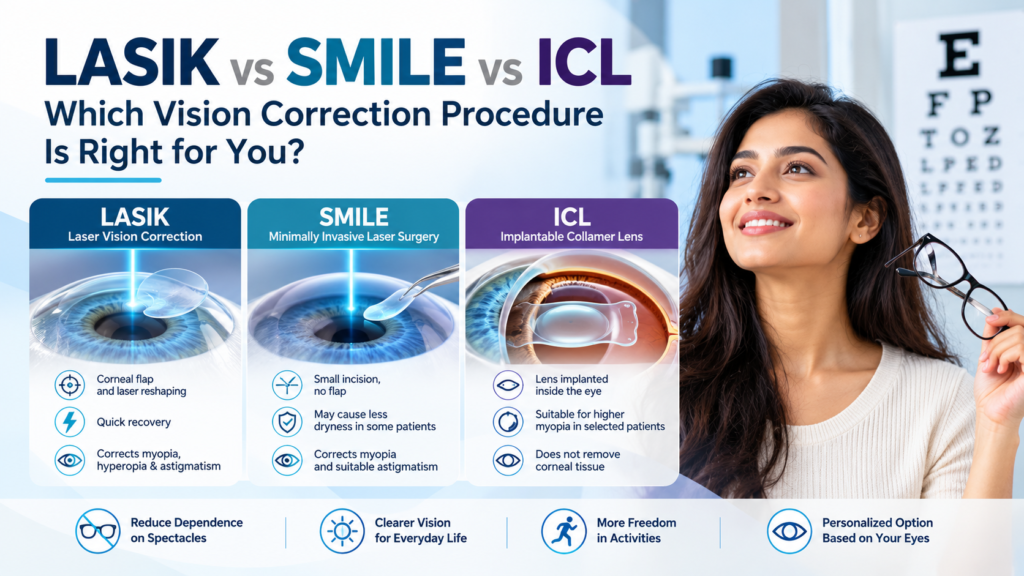
| Feature | LASIK | SMILE | ICL |
|---|---|---|---|
| Procedure type | Laser corneal reshaping | Laser lenticule removal | Implantable lens |
| Main technique | Corneal flap and laser | Small incision, no LASIK flap | Lens placed inside eye |
| Common correction | Myopia, hyperopia, astigmatism | Myopia and suitable astigmatism | Primarily myopia and suitable astigmatism |
| Corneal tissue removal | Yes | Yes | No corneal reshaping |
| Vision recovery | Often relatively rapid | May be slightly slower initially | Often improves within days, varies |
| Thin corneas | May be unsuitable | Not automatically suitable | May be considered in selected patients |
| Dry eye considerations | Can worsen dryness | May cause less dryness in some patients | Does not involve laser corneal reshaping |
| Main procedure-specific concern | Flap-related complications | Lenticule-related complications | Intraocular surgical risks |
| Reversibility | Corneal change is permanent | Corneal change is permanent | Lens removable, effects not necessarily reversible |
Important: None of these procedures is universally safer, better, or more effective for every patient. Results depend on individual eye measurements, surgical technique, the specific technology used, and appropriate patient selection.
LASIK vs SMILE vs ICL: Which Is Better for High Eye Power?
Patients with a high spectacle number often ask whether laser eye surgery is possible.
The answer depends on more than prescription strength alone.
For example:
- LASIK may be suitable for certain low to moderate refractive errors when sufficient healthy corneal tissue is available.
- SMILE may be considered for qualifying myopic prescriptions when corneal measurements are suitable.
- ICL may be an alternative for some patients with higher myopia or those unsuitable for corneal laser procedures.
However, ICL is not automatically the best option for every person with high eye power.
The eye specialist must also evaluate the depth of the anterior chamber, eye pressure, endothelial cell health, retinal health, and other factors.
The safest decision is based on a complete eye examination, not simply the number written on your spectacle prescription.
Which Procedure Is Better for Thin Corneas?
Corneal thickness plays an important role in laser vision correction.
LASIK and SMILE both alter corneal tissue, so the surgeon must carefully evaluate corneal thickness, shape, and the estimated tissue remaining after treatment.
If the cornea is too thin, irregular, or affected by a condition such as keratoconus, laser corneal reshaping may not be recommended.
Some patients who are unsuitable for LASIK or SMILE may be assessed for ICL.
Other alternatives, including surface laser procedures such as PRK, may also be considered in selected cases.
The correct choice requires corneal mapping and a comprehensive examination.
Which Is Better for Patients with Dry Eyes?
Dry eye disease is an important consideration before refractive surgery.
LASIK can cause or worsen dry eye symptoms, particularly during postoperative recovery.
SMILE may preserve more corneal nerves than LASIK in certain circumstances and may be associated with less postoperative dryness in some patients.
However, SMILE can still cause dry eye symptoms.
ICL does not require laser reshaping of the cornea, although it has different intraocular surgical risks.
If you already have burning, watery, or uncomfortable eyes, your doctor may recommend evaluating and treating the ocular surface before considering vision correction.
Patients with significant dry eye symptoms should not choose a procedure based only on advertisements describing it as painless, flapless, or dry-eye-free.
Recovery After LASIK, SMILE and ICL
Recovery varies from person to person.
LASIK recovery
Many patients notice visual improvement within the first day or two, although fluctuations can continue during healing.
Temporary dryness, glare, and sensitivity to light may occur.
SMILE recovery
Vision often improves over the first several days, although some patients experience temporary haze or fluctuating clarity.
Recovery can be slower initially than LASIK for certain visual measures.
ICL recovery
Many patients notice improved vision within days, but healing and stabilization vary.
Follow-up visits are especially important to monitor eye pressure, lens position, and other postoperative findings.
For all three procedures, follow your surgeon’s instructions regarding eye drops, protective care, activity restrictions, and follow-up appointments.
Do not rub your eyes or resume activities against your doctor’s advice.
Can LASIK, SMILE or ICL Remove Spectacles Permanently?
Many patients search online for ways to remove spectacles permanently.
Refractive surgery can significantly reduce dependence on glasses, and some patients may no longer need spectacles for many daily activities.
However, no procedure can guarantee perfect spectacle-free vision for life.
There are several reasons:
- Some patients may have a small amount of residual refractive error.
- Vision can change over time.
- Presbyopia can create a need for reading glasses with age.
- Cataracts and other eye conditions may affect vision later.
- Additional correction may sometimes be necessary.
LASIK and SMILE permanently change corneal shape, but this does not mean your eyesight can never change again.
ICL provides vision correction through an implanted lens, but future eye changes may still affect visual needs.
The realistic goal is to reduce dependence on spectacles while maintaining eye safety and good visual quality, rather than promise a lifetime without glasses.
How Do Eye Doctors Decide Which Procedure Is Right for You?
Before recommending vision correction surgery, an eye specialist usually performs a detailed eligibility assessment.
This may include:
- Spectacle power and refraction: To measure your vision correction requirements.
- Prescription stability: To check whether your eye power has changed recently.
- Corneal topography or tomography: To examine the shape and structure of the cornea.
- Corneal thickness measurement: To assess suitability for laser procedures.
- Dry eye evaluation: To identify tear film or ocular surface problems.
- Eye pressure assessment: To evaluate relevant risks.
- Retinal examination: Particularly important in patients with high myopia.
- Additional ICL measurements: Such as anterior chamber depth and endothelial cell evaluation when indicated.
Your eye doctor will also discuss your age, general health, medications, lifestyle, visual expectations, and risk tolerance.
Not every test is needed for every patient, and being suitable for surgery does not mean you must undergo it.
Questions to Ask Before Vision Correction Surgery
Before deciding on a procedure, ask your eye specialist:
- Am I medically eligible for LASIK, SMILE or ICL?
- Which procedure is most suitable for my spectacle power and eye measurements?
- What results can I realistically expect?
- What complications are possible in my case?
- What are the chances I may still need spectacles?
- How long might recovery take?
- How many follow-up visits will I need?
- Are non-surgical options or other refractive procedures more appropriate?
A thorough consultation should help you understand the benefits, alternatives, limitations, and risks before providing informed consent.
Frequently Asked Questions
1. Which is better: LASIK, SMILE or ICL?
There is no single best procedure for everyone. LASIK, SMILE and ICL treat refractive errors differently. The most appropriate option depends on your prescription, corneal health, internal eye measurements, age, and other clinical factors.
2. Is SMILE safer than LASIK?
SMILE avoids creating a LASIK-style flap and may reduce certain flap-related risks. However, both procedures have potential complications. Safety depends on appropriate patient selection, clinical findings, and surgical care.
3. Is ICL better than LASIK for high power?
ICL may be suitable for some people with high myopia who are not ideal candidates for LASIK. However, it involves surgery inside the eye and has its own risks. A complete assessment is essential.
4. Is LASIK eye surgery painful?
Anesthetic eye drops are used to reduce discomfort during LASIK. Patients may feel pressure or temporary discomfort. Some irritation, watering, or sensitivity can occur during recovery.
5. Can ICL surgery be reversed?
The implanted ICL can usually be surgically removed or replaced if necessary. However, this requires another operation and does not guarantee reversal of every change or complication.
6. Can I remove my spectacles permanently?
Refractive surgery can reduce or sometimes eliminate the need for distance spectacles, but it cannot guarantee lifelong freedom from glasses. Age-related changes and other eye conditions can affect future vision.
7. How do I know whether I am eligible for laser eye surgery in Yavatmal?
A detailed vision correction eligibility evaluation is needed. Your eye specialist can assess your prescription, corneal measurements, eye health, and personal risk factors to determine suitable options.
Looking for Vision Correction Guidance in Yavatmal?
If you are considering LASIK, SMILE or ICL, the first step is understanding your eyes rather than choosing a procedure based on its popularity.
At Drushti Eye Care, Yavatmal, you can seek professional guidance about your vision correction needs and the next steps for evaluating your eligibility.
A detailed assessment can help determine whether refractive surgery may be appropriate or whether other vision correction options should be considered.
Book a Vision Correction Eligibility Evaluation
Want to know whether LASIK, SMILE or ICL may be right for you?
Schedule a vision correction eligibility evaluation at Drushti Eye Care, Yavatmal, and discuss your spectacle number, eye health, available options, and realistic expectations with a qualified eye specialist.
Drushti Eye Care, Yavatmal
Book Your Eye Consultation Today
Note: Availability of individual procedures, advanced testing, and surgical referral services should be confirmed directly with the clinic.
Medical Disclaimer
This article is intended for general educational purposes only and does not replace professional medical advice, diagnosis, or treatment. Refractive surgery eligibility and outcomes vary between patients. All surgical decisions should be made after examination and informed consultation with a qualified ophthalmologist.