You have worn glasses since college, and now you are past 40 and finally considering getting rid of them. The first thing you search is whether LASIK after 40 is still an option. The honest answer is: sometimes yes, sometimes no, and sometimes there is a better procedure altogether. This post walks through what changes in your eyes after 40, where LASIK still fits, where it does not, and the alternatives that may actually serve you better. No hype, just the information you need before you book an evaluation.
What happens to your eyes after 40
Two things change, and understanding both is the key to the whole decision.
The first is presbyopia. The natural lens inside your eye, the one sitting behind the coloured iris, gradually stiffens with age. It loses its ability to flex and shift focus from far to near. That is why you start needing reading glasses or holding your phone further away. Everyone gets this, and no amount of fitness or diet prevents it.
The second is the slow, early beginning of a cataract. After 40 the same lens that is stiffening also starts to lose transparency, very gradually. In your forties this is usually unnoticeable. By the mid-fifties or sixties it can begin to cloud vision. This matters for LASIK after 40 because the laser reshapes the cornea (the front window), but it cannot do anything about a lens that is changing further inside.
Does LASIK have an age limit?
There is no fixed LASIK age limit in the way people imagine — no rule that says the door shuts at 40 or 45. If your distance glasses number is stable, your corneas are healthy and thick enough, and you have no early cataract forming, LASIK can still correct your distance vision perfectly well whether you are 42 or 52.
The catch, and it is a real one, is that LASIK fixes distance but it does not fix presbyopia. So after a successful LASIK at 45, you might see the road perfectly without glasses but still need a pair for reading, your phone, or threading a needle. If your main frustration is reading glasses and near work, LASIK alone will not solve that problem. This is where the conversation branches.
Can LASIK fix reading glasses? The monovision option
One approach that works for some patients is monovision LASIK. The idea is deliberate: the surgeon corrects one eye fully for distance and leaves the other slightly short-sighted so it favours near work. Your brain learns to lean on the right eye for the right task. Many people adapt well, and it can give you a functional range from driving to reading without reaching for any glasses at all.
The trade-off is that depth perception can feel slightly off, and not everyone’s brain adjusts comfortably. Most surgeons will offer a trial with contact lenses first — one set at distance, one at near — so you can test the feeling before committing to a permanent change. If the trial feels natural, monovision LASIK after 40 becomes a genuine presbyopia treatment option.
LASIK after 45 and beyond: when the lens starts to matter
As you move into your late forties and fifties, two things work against a straightforward LASIK:
- Presbyopia deepens, so the reading-glasses gap widens even if LASIK fixes the distance.
- The natural lens may show early clouding. If a cataract is forming, reshaping the cornea with a laser now just means you will need cataract surgery in a few years anyway, and the corneal change can complicate that later surgery.
This is why a thorough evaluation matters more at this age than it does for a 25-year-old. The question is no longer just “can LASIK fix my number?” but “is LASIK the smartest long-term move, given where my lens is heading?”
LASIK versus lens replacement: which is better after 40?
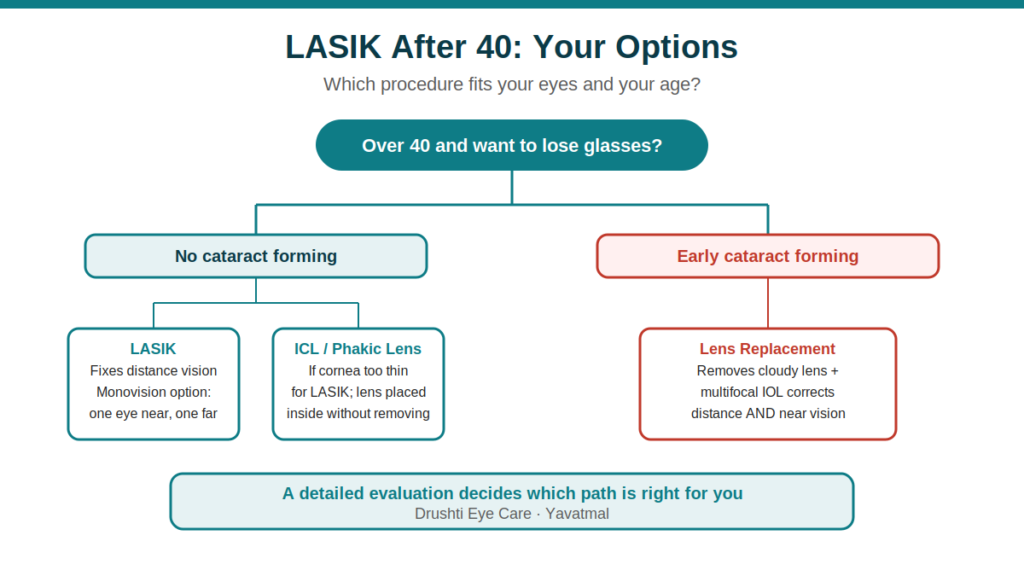
Here is where the conversation gets practical. When you weigh LASIK versus lens replacement, the choice depends on whether your natural lens is still clear.
If the lens is clear and healthy — LASIK (or monovision LASIK) can correct your distance vision. You accept that reading glasses may still be needed, or you try monovision to reduce that. In some cases, an ICL (implantable collamer lens) is better than LASIK if the cornea is too thin or the number is very high, because the lens goes inside the eye without removing anything.
If an early cataract is forming — a refractive lens exchange (essentially early cataract surgery with a premium multifocal or trifocal IOL) often makes more sense. It removes the lens that was going to cloud anyway and replaces it with a permanent artificial lens that corrects both distance and near vision. You skip the reading glasses entirely, and you skip the cataract surgery you would have needed later. Two problems solved in one sitting.
Neither option is better in every case. The right answer comes from the evaluation, not from the marketing.
Can seniors get LASIK?
Patients in their sixties and seventies sometimes ask whether LASIK is still possible. In most cases at that age, the natural lens has changed enough that a lens-based procedure — standard or premium cataract surgery — gives a far better and more lasting result than reshaping a cornea in front of an aging lens. That said, there are specific situations (such as a residual number after cataract surgery) where a corneal laser touch-up is helpful even at that age. The evaluation decides.
Who makes a good candidate for LASIK after 40
You are likely a good fit if:
- Your distance glasses number has stayed stable for at least a year
- Your corneas are healthy, thick enough, and free of disease
- You have no early cataract showing on a slit-lamp examination
- You understand that reading glasses may still be needed (or you are open to a monovision trial)
- You are not pregnant or nursing (hormonal changes shift the number temporarily)
You are probably better served by a lens-based procedure if you already have early lens cloudiness, if your presbyopia is your main complaint, or if you are in your late fifties or older.
What the evaluation looks like
At Drushti Eye Care, the pre-procedure evaluation for anyone considering LASIK or lens replacement covers:
- Your exact distance and near number
- Corneal thickness and shape (topography)
- Slit-lamp check for early cataract or lens changes
- Retina and optic nerve health
- Tear-film quality (dry eyes affect healing)
- A discussion of your daily visual needs — driving, reading, screen work, farm work — so the recommendation actually fits your life
If monovision is being considered, we usually suggest a contact-lens trial for a week or two before anything permanent. The goal is to reach a confident decision, not to push a procedure.
Why families trust Drushti Eye Care
Over the last 15 years we have looked after more than 10,000 patients, with both refractive (LASIK) and lens-based (cataract/IOL) capabilities under one roof. Dr. Subodh Purohit leads the surgical care and walks patients through this exact decision regularly — LASIK, monovision, ICL, or lens replacement — matching the procedure to the patient, not the other way around. Families from Yavatmal and nearby towns like Wani, Pusad, Pandharkawda and Darwha come in for exactly this kind of honest evaluation. You can also read our broader guide on why a yearly eye check after 40 matters.
Over 40 and want to lose your glasses?
Book an evaluation and find out which procedure actually fits your eyes and your life.
Call or WhatsApp: [Clinic Phone Number]
Drushti Eye Care, [Clinic Address], Yavatmal · Contact us
Frequently asked questions
Can you get LASIK after 40?
Yes, provided your distance number is stable, your corneas are healthy, and no early cataract is forming. The main limitation is that LASIK fixes distance vision but does not correct presbyopia, so reading glasses may still be needed.
Is there an age limit for LASIK?
There is no fixed LASIK age limit. Suitability depends on the health of the cornea and the natural lens, not on a number. After the mid-fifties, a lens-based procedure often gives a better long-term result.
Can LASIK fix reading glasses?
Standard LASIK does not correct presbyopia. Monovision LASIK, where one eye is set for distance and the other for near, can reduce or remove the need for reading glasses in many patients. A contact-lens trial tests this before committing.
What is monovision LASIK?
The surgeon corrects one eye for distance and deliberately leaves the other slightly near-sighted. Your brain learns to use the right eye for the right task. It works well for many people but not everyone, which is why a trial comes first.
What is the difference between LASIK and lens replacement?
LASIK reshapes the cornea (the front window) and does not touch the lens inside. Lens replacement removes the natural lens and puts in an artificial one. If a cataract is forming, lens replacement solves both the number and the cataract in one procedure.
Can seniors get LASIK?
In most cases, patients in their sixties and beyond benefit more from a lens-based procedure such as cataract surgery with a premium IOL. A corneal laser touch-up can still help in specific situations, such as a residual number after cataract surgery.