You have probably felt it without knowing what to call it. A long stretch on the laptop, a few hours of scrolling your phone, and then your eyes feel tired, gritty and dry. Your head might hurt a bit, or your neck goes stiff. Doctors call this digital eye strain, and it is one of the most common complaints we hear at our clinic, especially from students, working professionals and anyone whose day revolves around a screen. The good news is that it is almost always fixable with a few small habits.
Why screens tire your eyes out
Your eyes are built to move and refocus throughout the day, near and far, constantly shifting. A screen locks them into a close-up fixed position for hours. That steady close focus forces the tiny muscles inside the eye to clench, which is what makes them ache. On top of that, you blink far less when you concentrate on a screen. A normal blink rate is about 15 times a minute; on a screen, it drops below half that. Fewer blinks means the tear film dries out and your eyes feel gritty. Neither of these is dangerous, but both are genuinely uncomfortable.
Common signs of digital eye strain
- Dry, burning or watery eyes
- A tired, heavy feeling in and around the eyes
- Headache, especially across the forehead
- Blurred vision that clears when you look away
- Stiff neck and shoulders
If these show up mostly after screen use and ease once you stop, digital eye strain is almost certainly the cause.
The 20-20-20 rule (and why it works)
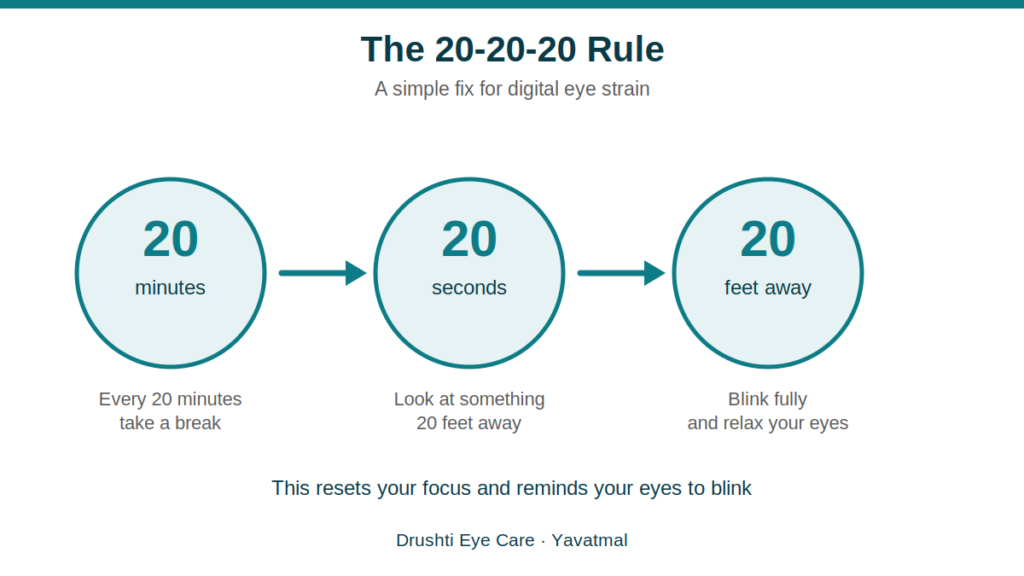
Every 20 minutes, look at something at least 20 feet away for 20 seconds. That is the whole rule. It works because it forces the focusing muscles to relax, and the act of looking up usually triggers a few full blinks, which resets the tear film. You can set a quiet timer on your phone if you tend to lose track. One small break like this matters more than a long rest at the end of the day, because the strain builds while you are staring, not after. The American Academy of Ophthalmology recommends the same approach.
Other habits that help
- Blink on purpose. Sounds odd, but consciously blinking a few full, slow blinks every few minutes rewets the eye surface.
- Keep the screen at arm’s length. Holding your phone too close makes the eyes work harder. Laptops and monitors should sit roughly an arm’s length away, with the top of the screen at or just below eye level.
- Reduce glare. A bright window behind the screen, or an overhead light bouncing off the glass, adds visual noise the eyes have to fight through. Angle the screen or use a matte screen protector.
- Increase text size. If you find yourself leaning in, make the font bigger. Your eyes will thank you.
- Keep the room well lit. Working in a dark room with a bright screen forces the pupils to keep adjusting, which tires the eyes faster.
Do blue-light glasses help?
They are popular and heavily marketed, so this is worth an honest answer. Most research so far has not found strong evidence that blue-light-blocking lenses reduce digital eye strain. The strain comes from fixed focus and reduced blinking, not from the light colour. If a pair of glasses makes you feel better, use them, but they are not a substitute for the habits above. Your money is better spent on a well-designed pair of prescription glasses if you need them, or on a matte screen protector.
When screen strain might actually be something else
Sometimes what feels like screen tiredness is actually an uncorrected glasses number, or a dry-eye condition that the screen just makes worse. If you follow the habits above and the discomfort still does not ease, it is worth getting a proper eye check-up. A small uncorrected power, even half a number, can cause headaches and fatigue that no amount of 20-20-20 will fix. At Drushti Eye Care, we see this regularly: a patient walks in blaming the screen, and walks out with a small-number correction that solves everything.
Screen time for children
Children’s eyes strain faster because they hold screens even closer and do not think to take breaks. If your child complains of headaches after online classes, or rubs their eyes at the end of the day, the first step is limiting continuous screen time and encouraging outdoor play. An eye check for children is also a good idea to rule out a hidden glasses number.
Why families come to Drushti Eye Care
Over the last 15 years we have looked after more than 10,000 patients, with complete refraction and dry-eye assessment available under one roof and care led by Dr. Subodh Purohit. Whether it turns out to be a simple screen habit or a hidden glasses number, we give you a clear answer in one visit. Families from Yavatmal and nearby towns like Wani, Pusad, Pandharkawda and Darwha come in for exactly this kind of check.
Screens wearing your eyes out?
Book a quick check to rule out a hidden glasses number or dry-eye issue.
Call or WhatsApp: [Clinic Phone Number]
Drushti Eye Care, [Clinic Address], Yavatmal · Contact us
Frequently asked questions
Does screen use damage your eyesight?
Screens cause strain, not permanent damage. However, if an uncorrected glasses number is hiding underneath, the strain gets worse. A check-up sorts out which it is.
What is the 20-20-20 rule?
Every 20 minutes, look at something at least 20 feet away for 20 seconds. It relaxes the focusing muscles and triggers a few blinks to rewet the eyes.
Why do my eyes feel dry after screen use?
You blink far less while concentrating on a screen, sometimes half the normal rate, so the tear film dries out. Conscious blinking and regular breaks fix this.
Do blue-light glasses really help?
Most research has not found strong evidence that they reduce digital eye strain. The strain comes from fixed focus and reduced blinking, not from the light colour.
When should I see a doctor for eye strain?
If the discomfort continues even after following the 20-20-20 rule and adjusting your screen habits, a check-up can reveal a hidden glasses number or dry-eye condition.