Does your child sit too close to the television, squint while looking at the classroom board, or frequently complain about headaches?
As parents, we pay close attention to our children’s nutrition, education, and overall health. But one important aspect often goes unnoticed — their eyesight.
Children may not always realize that their vision is blurry. Unlike adults, they may not know what clear vision should look like or how to explain their difficulties.
Instead, they may develop small habits such as holding books very close, rubbing their eyes, or avoiding reading.
These everyday behaviours can sometimes be signs your child needs glasses or an indication of another vision problem requiring professional assessment.
At Drushti Eye Care, Yavatmal, we encourage parents to recognize potential eye problems early and seek appropriate eye examinations when needed.
In this article, we’ll explore seven warning signs, common childhood vision problems, and when parents should schedule a comprehensive eye examination.
Why Is Good Eyesight Important for Children?
Clear vision plays an important role in a child’s everyday development.
From reading books and copying notes from the blackboard to playing sports and exploring the world, children rely on their eyesight for many activities.
Undetected vision problems can contribute to:
- Difficulty seeing classroom boards.
- Discomfort during reading and homework.
- Reduced participation in visually demanding activities.
- Trouble recognizing distant objects.
- Frequent visual fatigue.
- Frustration during schoolwork.
Sometimes, a child who appears distracted or uninterested in studies may actually be struggling to see clearly.
However, vision problems are not the only cause of learning or concentration difficulties.
Early detection is particularly important because certain childhood eye conditions can interfere with normal visual development if left untreated.
7 Signs Your Child Needs Glasses
Parents should observe the following symptoms and behaviours. While they do not always mean a child needs spectacles, they can indicate that an eye examination is necessary.
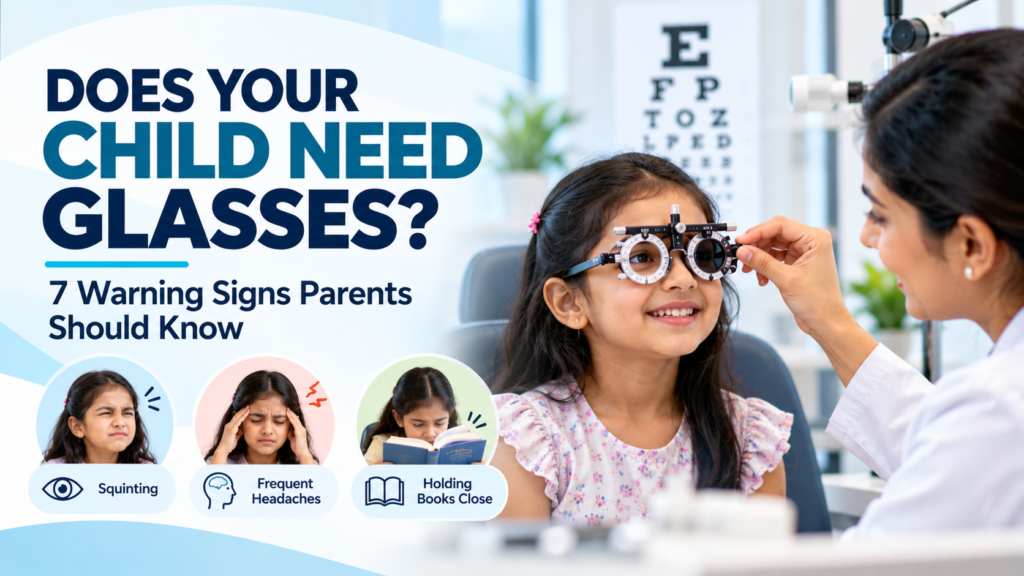
1. Squinting to See Clearly
Does your child narrow their eyes while looking at distant objects?
Squinting can temporarily improve the clarity of an image by reducing the amount of scattered light entering the eye.
It is one of the most recognizable warning signs of a possible refractive error.
Children with myopia, commonly called nearsightedness, may squint when looking at:
- Classroom blackboards.
- Television screens.
- Road signs.
- Objects across a playground.
Persistent squinting in children should not be ignored.
An eye examination can help determine whether a spectacle prescription or another form of care is needed.
2. Sitting Too Close to the Television or Holding Books Very Close
Have you noticed your child sitting unusually close to the TV or bringing a mobile phone or book close to their face?
This behaviour may indicate difficulty seeing clearly at normal viewing distances.
Children with myopia often see nearby objects more clearly than distant objects.
Some children naturally prefer close viewing, so this habit alone does not confirm an eyesight problem.
However, if it happens frequently or is accompanied by other symptoms, an eye examination is recommended.
Parent tip: Observe whether your child also struggles to see objects far away, such as signs or classroom boards.
3. Frequent Headaches or Eye Strain
Does your child complain about headaches after school, reading, or completing homework?
Uncorrected refractive errors can sometimes contribute to visual discomfort and headaches.
Possible symptoms include:
- Headaches after reading.
- Tired eyes during homework.
- Frequent breaks while studying.
- Difficulty concentrating on close-up tasks.
- Complaints of blurry vision.
However, headaches can also result from poor sleep, migraine, dehydration, or other medical conditions.
If headaches occur frequently, consult an appropriate healthcare professional and consider an eye examination.
4. Rubbing Their Eyes Frequently
Children often rub their eyes when they are sleepy or tired.
But frequent eye rubbing, especially during reading or screen use, may indicate discomfort.
Possible reasons include:
- Eye strain.
- Allergies.
- Dryness.
- Irritation.
- Uncorrected vision problems.
Eye rubbing does not automatically mean your child needs glasses.
If you notice persistent rubbing, redness, watering, or irritation, schedule an eye assessment to identify the underlying cause.
5. Tilting Their Head or Covering One Eye
Does your child frequently tilt their head while reading or watching television?
Do they sometimes cover or close one eye to focus better?
These behaviours may indicate difficulties with eye alignment, unequal vision between the eyes, or other visual problems.
In some cases, children may adjust their head position to compensate for double vision or blurry eyesight.
An eye that consistently turns inward or outward should also be assessed promptly.
Important: Persistent head tilting, covering one eye, or eye misalignment can indicate a condition that requires more than spectacles. Professional examination is especially important.
6. Difficulty Reading or Complaints About Blurry Vision
Some children experience difficulty reading even when they enjoy learning.
Parents or teachers may notice that the child:
- Loses their place while reading.
- Frequently skips lines.
- Uses a finger to follow each word.
- Avoids books or drawing activities.
- Complains that letters look blurry.
- Struggles to copy notes from the classroom board.
These can sometimes be signs of blurry vision in kids or another visual difficulty.
However, reading challenges may have several causes, including educational and developmental factors.
An eye examination helps determine whether an eyesight problem is contributing to the difficulty.
7. Avoiding Activities That Require Clear Vision
Has your child suddenly lost interest in reading, drawing, outdoor games, or other activities that previously seemed enjoyable?
Sometimes, children avoid activities that make them uncomfortable.
A child who struggles to see a ball clearly may become less interested in sports.
Another child may avoid reading because focusing on text feels difficult.
Parents may interpret this as a behavioural issue, but underlying vision problems are worth considering.
If your child shows these behaviours regularly, a comprehensive eye examination can help identify or rule out an eye-related cause.
Common Eyesight Problems in Children
Several conditions can affect children’s vision.
Myopia (Nearsightedness)
Children with myopia usually see nearby objects clearly but may struggle to see distant objects.
They may squint, move closer to the television, or have trouble seeing the classroom board.
Hyperopia (Farsightedness)
Hyperopia occurs when the eye’s focusing power is insufficient for its length.
Some children can compensate for farsightedness, but higher levels may contribute to visual discomfort, blurred vision, or eye alignment problems.
Astigmatism
Astigmatism can cause blurry or distorted vision at different distances.
It may occur along with myopia or hyperopia.
Amblyopia (Lazy Eye)
Amblyopia occurs when vision does not develop normally in one or both eyes during childhood.
It can be caused by unequal refractive errors, eye misalignment, or conditions obstructing normal vision.
Early diagnosis and treatment are important because the developing visual system responds best during childhood.
Strabismus (Eye Misalignment)
Strabismus occurs when the eyes do not point in the same direction.
One eye may turn inward, outward, upward, or downward.
Treatment depends on the cause and may include glasses, patching for associated amblyopia, other therapies, or surgery.
Not every childhood eye condition can be treated with glasses alone. An accurate diagnosis is essential.
At What Age Should Children Have Their Eyes Checked?
Children’s vision should be assessed at age-appropriate intervals, even when parents have not noticed obvious problems.
Babies and Infants
Eye health and visual development are assessed during routine newborn and infant healthcare visits.
Abnormal eye appearance, unusual pupil reflections, poor visual tracking, or persistent eye misalignment require professional attention.
Toddlers and Preschool Children
Children between three and five years of age should undergo age-appropriate vision screening.
Special techniques can help assess children who cannot yet read letters.
School-Age Children
From age five onward, vision screening should continue during routine healthcare or school assessments.
In general, repeat screening every one to two years after age five is recommended, unless individual risk factors or previous findings require a different schedule.
When Is a Comprehensive Eye Examination Needed?
An examination by an eye care professional is particularly important when:
- Your child fails a school or routine vision screening.
- Your child reports blurry vision.
- You notice persistent squinting or unusual visual behaviour.
- One eye appears to turn inward or outward.
- There is a family history of important childhood eye conditions.
- Your child has a condition associated with an increased risk of eye problems.
- Previous screening results are unclear.
A normal school vision screening does not completely rule out all eye conditions.
What Happens During a Child Eye Checkup?
Parents sometimes worry that their child will not cooperate during an eye examination.
Fortunately, eye specialists can use age-appropriate methods to evaluate children.
Depending on the child’s age and symptoms, a child eye checkup may involve the following.
1. Vision Testing
The doctor checks how clearly the child can see.
Young children may be tested using pictures, shapes, or age-appropriate vision charts rather than traditional letters.
2. Refraction Assessment
Refraction testing determines whether the child has myopia, hyperopia, or astigmatism.
In some children, special dilating drops are used to temporarily relax the focusing muscles and obtain more accurate measurements.
3. Eye Alignment Assessment
The doctor examines how the eyes move and work together.
This helps detect strabismus and other alignment problems.
4. Eye Health Examination
The ophthalmologist may examine the eyelids, cornea, lens, retina, and other eye structures.
The exact tests depend on the child’s age, symptoms, and examination findings.
5. Personalized Treatment Advice
If glasses are required, the doctor recommends an appropriate prescription.
If another eye problem is identified, further treatment, monitoring, or specialist referral may be necessary.
Can Wearing Glasses Make a Child’s Eyes Weaker?
No. Wearing properly prescribed glasses does not make a child’s eyes weaker.
This is a common misconception among parents.
Glasses help the eyes focus light correctly and provide clearer vision.
For children with certain refractive errors, wearing glasses as prescribed may also support normal visual development and help prevent or treat amblyopia.
Avoid delaying prescribed spectacles because of the belief that the eyes will become dependent on them.
As a child grows, their spectacle prescription may change naturally. This does not mean the glasses caused their eyesight to worsen.
How Can Parents Support Healthy Vision Habits?
Along with appropriate eye examinations, simple daily habits can support children’s eye comfort and visual development.
Encourage Outdoor Activities
Spending time outdoors is associated with a lower risk of developing myopia in children.
Encourage age-appropriate outdoor play while taking suitable sun-safety precautions.
Encourage Regular Screen Breaks
For children using digital devices, encourage frequent breaks.
The 20-20-20 rule can help reduce focusing discomfort: every 20 minutes, look approximately 20 feet away for 20 seconds.
Maintain Comfortable Reading Distance
Encourage children to read at a comfortable distance rather than holding books extremely close to their faces.
Use Good Lighting
Provide comfortable lighting for reading, drawing, and homework.
Follow the Prescribed Spectacle Routine
If your child needs glasses, encourage them to wear them according to the eye doctor’s instructions.
Attend Recommended Follow-Ups
Children’s eyes can change as they grow.
Follow-up examinations help ensure that treatment and prescriptions remain appropriate.
When Should You Seek Urgent Eye Care for Your Child?
Some symptoms should be assessed urgently rather than waiting for a routine appointment.
Seek prompt medical care if your child develops:
- Sudden vision loss or a major sudden vision change.
- Severe eye pain.
- An eye injury, particularly involving chemicals or sharp objects.
- A white or abnormal-looking pupil reflection.
- New persistent double vision.
- Severe eye redness with pain or significant light sensitivity.
A white pupil reflection in photographs, especially when repeatedly seen in one eye, should be evaluated promptly because it can occasionally indicate a serious eye condition.
When Should You Visit a Children’s Eye Specialist in Yavatmal?
If you notice repeated squinting, headaches related to visual activities, unusually close viewing habits, or difficulty seeing classroom boards, consider scheduling an eye examination.
A qualified eye specialist can help determine whether the symptoms are caused by a refractive error or another eye condition.
For parents searching for a children’s eye specialist in Yavatmal, choosing a provider who can assess childhood vision and arrange appropriate specialist referral when needed is important.
At Drushti Eye Care, Yavatmal, parents can enquire about eye examinations and suitable next steps for their children’s vision concerns.
Frequently Asked Questions About Children’s Eyesight
1. What are the first signs a child needs glasses?
Common warning signs include squinting, sitting unusually close to the television, holding books close, frequent headaches, and difficulty seeing classroom boards. These signs suggest a need for an eye examination but do not confirm that glasses are necessary.
2. Can a five-year-old child need spectacles?
Yes. Children can require spectacles at different ages, including during preschool years. The need depends on the type and degree of refractive error, visual development, and eye health.
3. Does sitting close to the TV mean my child has weak eyesight?
Not always. Some children simply prefer sitting close. However, repeated close viewing combined with squinting or difficulty seeing distant objects may indicate myopia or another vision problem.
4. Can mobile phones cause eyesight problems in children?
Prolonged screen use can contribute to eye strain, dryness, and visual discomfort. Excessive near work may also be associated with myopia development or progression. Regular breaks and outdoor time are sensible habits.
5. Can children outgrow their glasses?
Some childhood refractive errors change as the eyes develop, and spectacle needs may increase or decrease. Whether glasses remain necessary depends on the underlying condition and follow-up findings.
6. Are headaches a sign that my child needs glasses?
Headaches can sometimes be associated with uncorrected refractive errors or visual discomfort, but they have many possible causes. Frequent headaches should be assessed medically.
7. What if my child passes the school vision screening?
Passing a vision screening is reassuring but does not rule out every eye problem. If your child has symptoms or risk factors, a comprehensive eye examination may still be recommended.
8. When should I book an eye checkup for my child?
Book an examination if your child has concerning visual symptoms, fails a screening, or has risk factors for eye conditions. Seek urgent medical attention for sudden vision loss, significant eye injury, or other emergency warning signs.
Clear Vision Can Make Childhood Easier
Children may not always tell you when they cannot see clearly — but their everyday habits can provide important clues.
Squinting, frequent headaches, holding books too close, and difficulty seeing distant objects may indicate an underlying vision problem.
Recognizing these signs early can help parents seek the right care before vision difficulties interfere with daily activities or healthy visual development.
Book Your Child’s Comprehensive Eye Examination
Noticed any of these seven warning signs in your child?
Schedule a child eye checkup at Drushti Eye Care, Yavatmal, to discuss your child’s symptoms and appropriate vision assessment.
Drushti Eye Care – Yavatmal
Book Your Child’s Eye Examination Today
Availability of pediatric eye examinations and any specialized treatment or referral services should be confirmed directly with the clinic.
Medical Disclaimer
This article is for general educational purposes only and does not replace professional medical advice, diagnosis, or treatment. Children with suspected vision problems should be assessed by an appropriately qualified eye care professional. Eye examination and screening requirements depend on age, medical history, symptoms, and individual risk factors.
Medical References
- American Academy of Ophthalmology — Eye Screening for Children: https://www.aao.org/eye-health/tips-prevention/children-eye-screening
- American Academy of Ophthalmology — Four Hidden Signs of Vision Problems in Kids: https://www.aao.org/eye-health/tips-prevention/four-hidden-signs-of-vision-problems-in-kids
- American Association for Pediatric Ophthalmology and Strabismus — Vision Screening Recommendations: https://patients.aapos.org/syndicated/vision-screening
- Johns Hopkins Medicine — How to Know if Your Child Needs Glasses: https://www.hopkinsmedicine.org/health/wellness-and-prevention/how-to-know-if-your-child-needs-glasses
- HealthyChildren.org — Warning Signs of Vision Problems in Infants & Children: https://www.healthychildren.org/english/health-issues/conditions/eyes/pages/warning-signs-of-vison-problems-in-children.aspx