
Does your vision feel cloudy, blurry, or foggy even after changing your glasses? Are bright lights causing discomfort, or is driving at night becoming difficult?
These may be early signs of a cataract, one of the most common causes of vision problems, particularly among older adults.
A cataract develops when the natural lens inside your eye gradually becomes cloudy, making it harder for light to pass through clearly.
In India, cataracts are commonly known as Motiyabind (मोतियाबिंद).
The good news is that cataracts can be treated effectively with modern surgical techniques. However, many patients have an important question:
When is the right time for cataract surgery?
Should you wait until your vision becomes extremely poor, or consider treatment when everyday activities become difficult?
In this guide, Drushti Eye Care, Yavatmal, explains common cataract symptoms, treatment options, surgery timing, recovery expectations, and the importance of professional eye examinations.
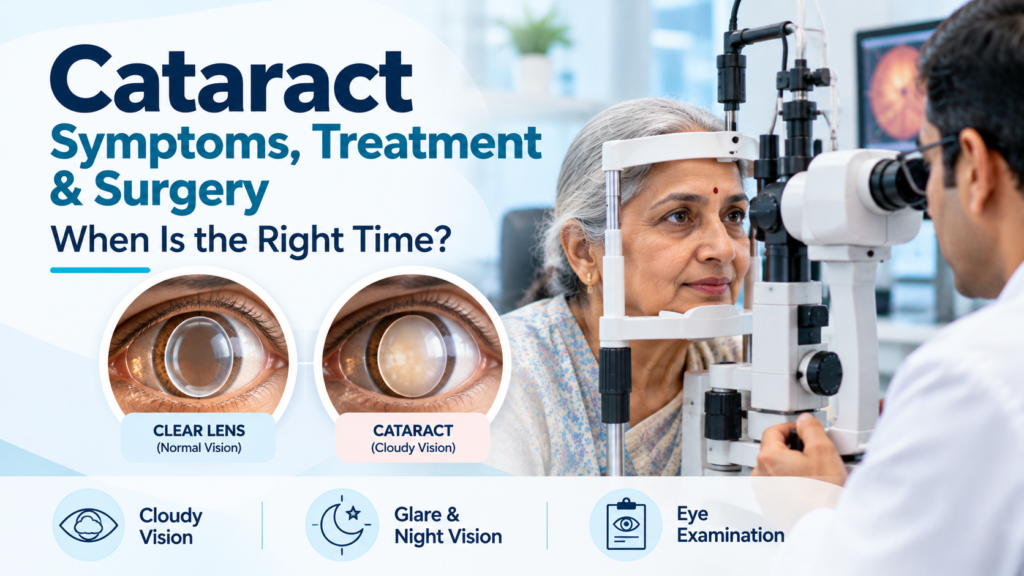
What Is a Cataract?
Inside each eye is a natural, normally clear lens that helps focus light onto the retina.
Over time, proteins within this lens can change and cause clouding. This clouding is called a cataract.
As the cataract develops, light cannot pass through the lens as clearly as before, causing vision to become blurry, dim, or hazy.
Many patients describe cataract-related vision as:
- Looking through a foggy window.
- Seeing objects through a cloudy glass.
- Experiencing increasing glare from headlights.
- Finding colours less bright than before.
- Needing more light to read comfortably.
Cataracts usually develop gradually. They may affect one or both eyes, and the severity can differ between eyes.
Early Cataract Symptoms You Should Never Ignore
Cataract symptoms can begin gradually and may be mistaken for normal age-related vision changes.
Recognizing these symptoms can help you seek timely medical attention.
1. Cloudy or Blurry Vision
One of the most common cataract symptoms is cloudy vision.
Objects may appear hazy, unclear, or less sharp than before.
You might notice difficulty reading newspapers, watching television, or recognizing faces from a distance.
2. Difficulty Seeing at Night
Cataracts can make night vision more challenging.
Driving after sunset may become uncomfortable because headlights and streetlights appear unusually bright.
3. Sensitivity to Bright Lights
You may experience increased glare from sunlight, headlights, or indoor lighting.
Some patients also notice halos around lights, particularly at night.
4. Frequent Changes in Spectacle Number
If your spectacle prescription changes repeatedly but your eyesight still does not feel clear, cataracts may be contributing to the problem.
5. Colours Appearing Faded or Yellowish
Cataracts can affect how you perceive colours.
Bright colours may look dull, faded, or slightly yellow.
6. Double Vision in One Eye
Some types of cataracts may cause ghosting or double images when looking through the affected eye.
This symptom can have other causes and should be evaluated professionally.
Important: Sudden vision loss, severe eye pain, or rapidly worsening vision is not typical of a slowly developing age-related cataract. These symptoms require urgent medical assessment.
What Causes Cataracts?
Ageing is the most common factor associated with cataract development.
However, cataracts can also develop because of other medical or environmental factors.
Common cataract risk factors
Ageing: Changes in the natural lens become more common as people grow older.
Diabetes: People with diabetes have an increased risk of cataract development.
Smoking: Tobacco use is associated with a greater risk of cataracts.
Long-term steroid use: Certain steroid medications, especially when used for prolonged periods, can increase cataract risk.
Eye injuries: Trauma may damage the natural lens and lead to cataract formation.
Ultraviolet exposure: Long-term sunlight exposure may contribute to cataract development.
Previous eye inflammation or surgery: Certain eye conditions and medical procedures can increase risk.
Although cataracts are more common in older adults, they can occasionally affect younger people and children.
When Is the Right Time for Cataract Surgery?
One of the biggest misconceptions about cataracts is that patients must wait until the cataract becomes completely mature before undergoing surgery.
In most cases, you do not need to wait until you can barely see.
The decision is based on how much the cataract affects your vision, daily activities, and overall eye health.
You may be ready to discuss cataract surgery if:
- Reading newspapers or books has become difficult.
- You struggle to watch television clearly.
- Night driving feels unsafe because of glare.
- Your vision remains blurry despite updated glasses.
- Cataracts interfere with work or household activities.
- You experience increasing difficulty with everyday tasks.
- Your ophthalmologist recommends removal to help examine or manage another eye condition.
If symptoms are mild and do not interfere significantly with daily life, surgery may not be immediately necessary.
A doctor may recommend updating your glasses, improving lighting, and monitoring the cataract.
The right timing is an individual decision made after an examination and discussion of the expected benefits and risks.
Can Cataracts Be Treated Without Surgery?
Many people search for cataract eye drops, natural remedies, or medicines that promise to dissolve cataracts.
However, there is currently no proven medication or eye drop that removes an established cataract.
In the early stages, certain measures may help you manage symptoms:
- Using an updated spectacle prescription.
- Improving lighting for reading.
- Reducing glare.
- Wearing appropriate sunglasses outdoors.
- Monitoring vision through regular eye examinations.
These approaches may improve visual comfort, but they do not remove the cloudy lens.
Cataract surgery is the established treatment for removing cataracts that significantly affect vision.
Avoid using unverified eye drops or home remedies claiming to cure motiyabind without surgery.
What Happens During Cataract Surgery?
Cataract surgery involves removing the cloudy natural lens and replacing it with a clear artificial lens.
This artificial lens is called an intraocular lens (IOL).
Step 1: Pre-Surgery Eye Examination
Before surgery, the ophthalmologist evaluates your eyesight, cataract severity, overall eye health, and measurements needed for lens selection.
Additional testing may be advised for patients with diabetes, glaucoma, retinal conditions, or other eye problems.
Step 2: Anesthesia and Preparation
The eye is usually numbed with anesthetic eye drops or another suitable technique.
Most patients remain awake during surgery, although medication may be given to help them relax.
Step 3: Removal of the Cloudy Lens
In modern phacoemulsification surgery, ultrasound energy is commonly used to break the cloudy lens into smaller pieces.
The lens material is then removed through a small incision.
Other surgical techniques may be used when clinically appropriate.
Step 4: Artificial Lens Implantation
A clear artificial lens is placed inside the eye to replace the removed natural lens.
The surgeon selects the appropriate IOL based on eye measurements and the patient’s visual needs.
Step 5: Postoperative Recovery
After surgery, the medical team checks the eye and provides instructions about eye drops, protection, activity restrictions, and follow-up examinations.
Many patients return home the same day.
Types of Lenses Used in Cataract Surgery
During a cataract operation, the cloudy natural lens is replaced with an artificial intraocular lens.
Different lens options may be considered.
| IOL type | Main purpose |
|---|---|
| Monofocal lens | Usually provides a chosen single focus, commonly distance vision |
| Toric lens | Helps correct suitable amounts of astigmatism |
| Multifocal lens | Designed to provide vision at multiple distances in selected patients |
| Extended Depth of Focus (EDOF) lens | Designed to extend the range of relatively clear vision |
Each lens has advantages and trade-offs.
For example, some presbyopia-correcting lenses may reduce dependence on glasses but can produce halos or glare in certain situations.
Not every lens is appropriate for every patient.
Your eye surgeon should recommend lens options based on your eye measurements, eye health, lifestyle, expectations, and budget.
Cataract Surgery Recovery: What Should You Expect?
Many patients are concerned about how long it will take to recover after a motiyabind operation.
Cataract surgery recovery varies from person to person, but many patients notice visual improvement within the first several days.
First 24–48 Hours
You may experience:
- Mild irritation or scratchiness.
- Temporary blurry vision.
- Sensitivity to light.
- Mild watering or redness.
Your ophthalmologist will explain which symptoms are expected and which require urgent attention.
First Week
Many patients can gradually resume light daily activities, depending on their surgeon’s instructions.
Vision often continues to improve as the eye heals.
Following Weeks
Your doctor will monitor healing and may check whether you need a new spectacle prescription.
Although improvement may occur early, complete healing can take several weeks, often around eight weeks.
Important Precautions After Cataract Surgery
Following postoperative instructions is essential.
Do:
- Use prescribed eye drops exactly as directed.
- Attend all scheduled follow-up visits.
- Wear a protective eye shield if recommended.
- Keep your hands clean before using eye medication.
- Ask your doctor when you may resume driving and other activities.
Avoid:
- Rubbing or pressing the operated eye.
- Getting dirty water, soap, or other irritants into the eye.
- Heavy lifting or strenuous activities until your surgeon permits them.
- Swimming before receiving medical clearance.
- Skipping prescribed medication or follow-up appointments.
Seek immediate medical attention after surgery if you experience worsening vision, significant eye pain, severe redness, new flashes, or a dark shadow across your vision.
Is Cataract Surgery Safe?
Cataract surgery is one of the most commonly performed eye operations and generally has a high success rate.
Most patients experience improved vision after surgery.
However, like every medical procedure, cataract surgery has potential risks.
These may include:
- Infection.
- Inflammation or swelling.
- Increased eye pressure.
- Bleeding.
- Retinal detachment.
- Problems involving the implanted lens.
- Persistent blurry vision.
- Posterior capsule opacification, sometimes called a secondary cataract.
Some patients may still require glasses after surgery, and vision may remain limited if other eye diseases are present.
Your ophthalmologist should explain the potential risks and expected outcomes for your specific eye condition.
Can Cataracts Come Back After Surgery?
Once the natural cloudy lens is removed, that cataract does not grow back.
However, some patients develop cloudiness of the thin capsule that holds the artificial lens.
This is called posterior capsule opacification (PCO).
It may occur months or years after surgery and can cause vision to become blurry again.
When appropriate, an ophthalmologist can usually treat PCO with a YAG laser capsulotomy.
This is different from the original cataract returning.
How Can You Reduce Your Risk of Cataracts?
While age-related cataracts cannot always be prevented, certain habits may support long-term eye health.
Protect Your Eyes from UV Rays
Wear sunglasses that block UVA and UVB radiation when outdoors.
Avoid Smoking
Smoking increases the risk of several eye conditions, including cataracts.
Manage Diabetes
Good diabetes management is important for protecting eye health.
Avoid Unnecessary Steroid Use
Use steroid medications, including steroid eye drops, only under appropriate medical supervision.
Have Regular Eye Examinations
An eye examination can identify cataracts and other conditions that affect vision.
These habits may reduce certain risks, but they cannot guarantee prevention.
When Should You Visit an Eye Specialist in Yavatmal?
If you are experiencing gradually worsening vision, increasing glare, difficulty reading, or frequent spectacle changes, it may be time for a professional eye examination.
A qualified eye specialist can determine whether cataracts are responsible for your symptoms or whether another condition is affecting your sight.
If you are searching for cataract treatment in Yavatmal, begin with a comprehensive eye assessment.
At Drushti Eye Care, Yavatmal, patients can enquire about an eye consultation to understand their vision concerns and suitable next steps.
Where surgery or additional specialized care is indicated, the appropriate options can be discussed according to the clinic’s available services and referral arrangements.
Frequently Asked Questions About Cataract Surgery
1. What are the first symptoms of cataracts?
Early cataract symptoms may include cloudy vision, glare, difficulty seeing at night, faded colours, and frequent changes in spectacle prescription.
2. When should cataract surgery be done?
Cataract surgery is commonly considered when vision problems begin interfering with daily activities such as reading, driving, watching television, or working. Your ophthalmologist will help determine the appropriate timing.
3. Is cataract surgery painful?
Cataract surgery is generally performed using local anesthesia, often with numbing eye drops. Most patients experience little pain during the procedure, although some pressure or discomfort may occur.
4. How long does cataract surgery recovery take?
Many patients notice improvement within days, but healing continues over several weeks. Complete healing often takes approximately eight weeks, depending on the individual.
5. Can motiyabind be cured without surgery?
There is currently no proven medication or eye drop that removes an established cataract. Surgery is the established method of removing the cloudy natural lens.
6. Will I need glasses after cataract surgery?
Some patients still require glasses for reading, distance vision, or other activities. This depends on the implanted lens, eye health, and visual requirements.
7. Can cataracts affect both eyes?
Yes. Cataracts commonly affect both eyes, although one eye may become more affected than the other.
8. Is cataract surgery safe for people with diabetes?
Many people with diabetes can undergo cataract surgery successfully. However, diabetic retinal disease and other eye conditions may influence surgical planning, recovery, and visual outcomes. A detailed preoperative assessment is essential.
Don’t Let Cloudy Vision Affect Your Everyday Life
Clear vision makes everyday moments easier — from reading your favourite book to recognizing loved ones and enjoying daily activities.
Cataracts are common, but you do not need to wait until your eyesight becomes severely affected before discussing your options.
Understanding cataract symptoms, treatment choices, and the right timing for surgery can help you make an informed decision about your eye health.
Schedule a Cataract Consultation
Are you experiencing blurry vision, increasing glare, or difficulty seeing at night?
Schedule a cataract consultation at Drushti Eye Care, Yavatmal, to discuss your symptoms, eye examination findings, and appropriate next steps.
Drushti Eye Care – Yavatmal
Book Your Eye Consultation Today
The availability of cataract surgery and specific surgical techniques should be confirmed directly with the clinic.
Medical Disclaimer
This article is intended for general educational and awareness purposes only. It does not replace professional medical advice, diagnosis, or treatment. Cataract surgery decisions depend on individual eye health, symptoms, examination findings, and an informed discussion with a qualified ophthalmologist.
Medical References
- National Eye Institute — Cataract Surgery: https://www.nei.nih.gov/eye-health-information/eye-conditions-and-diseases/cataracts/cataract-surgery
- American Academy of Ophthalmology — What Are Cataracts?: https://www.aao.org/eye-health/diseases/what-are-cataracts
- American Academy of Ophthalmology — Cataract Surgery Recovery: https://www.aao.org/eye-health/tips-prevention/safe-exercise-driving-cataract-surgery-recovery