
You just had your cataract surgery, you are home, and now your eye burns. It feels gritty, maybe a bit scratchy, and you are wondering whether something has gone wrong. This is one of the most searched concerns after the operation, and for good reason — your eye just went through a procedure, and it does not come with a pain-free guarantee on day one. The reassuring truth is that mild eye burning after cataract surgery is one of the most common and most temporary cataract surgery side effects. But there is a line between normal healing and a sign that you need to call your doctor, and this post draws it clearly.
Why your eye burns after surgery
During cataract surgery, a small incision opens the eye so the surgeon can remove the cloudy lens and place a clear artificial one. Even though modern phaco surgery is gentle and stitchless, the surface of the eye gets disturbed. The tiny nerves in the cornea, which normally tell your eye when to blink and when to make tears, take a few days to settle. Until they do, the eye often feels dry, gritty or like something is in it.
On top of that, the medicated drops you use after surgery — the antibiotic and the steroid — contain preservatives that can sting a little when they hit a surface that is still healing. So the burning you feel is usually a combination of a temporarily disrupted tear film and a healing surface reacting to necessary medication. Neither of these is dangerous.
Dry eyes after cataract surgery: the most common cause of burning
This deserves its own section because it catches so many patients by surprise. Dry eyes after cataract surgery are extremely common. The surgery temporarily reduces the corneal nerve signals that trigger blinking and tear production. The result is an eye that dries out faster than usual and feels gritty, burning, or scratchy, especially in air-conditioned rooms, in front of a fan, or after a long stretch of reading.
For most people this settles within a few weeks. Lubricating drops (artificial tears) used several times a day ease the discomfort while the nerves recover. Your surgeon will tell you which brand to use and how often. If the dryness persists beyond a couple of months, it is worth mentioning at your follow-up, because a small number of patients need a longer dry-eye management plan.
Other normal discomforts during cataract surgery recovery
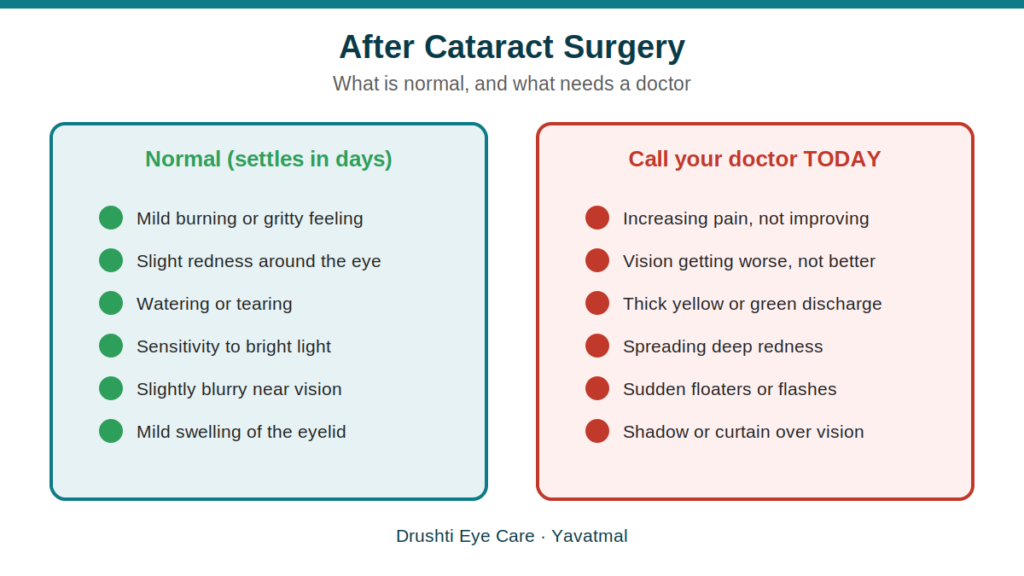
Besides burning, a few other things are common in the first few days and usually settle on their own:
- Mild redness — some redness after cataract surgery around the white of the eye and the eyelid is normal. It usually fades within a week.
- Watering or tearing — the eye overcompensates for the dryness by producing reflex tears, which can run down your cheek.
- Sensitivity to bright light — the new clear lens lets in more light than the old cloudy one did, so everything looks brighter for a while. Dark glasses outdoors help.
- Slightly blurry near vision — your eye is still settling, and inflammation inside can temporarily blur things. It clears over days.
- Mild eyelid swelling — the tissue around the eye can puff a little. Cool compresses on the closed lid help.
The general direction should always be improving. Day two should feel better than day one. Day five should feel noticeably better than day two. If discomfort stays the same or gets worse instead of better, that is the signal to pick up the phone.
How to use your prescribed drops correctly
Your drops are the single most important thing you control during cataract surgery recovery. Here is what matters:
- Follow the exact schedule your surgeon gave you. The antibiotic protects against infection. The steroid controls inflammation. Skipping doses or stopping early undoes both.
- Wash your hands before every drop.
- Wait at least five minutes between different drops so each one has time to absorb.
- Do not let the tip of the bottle touch the eye or the eyelashes.
- If lubricating drops are prescribed alongside, use them between the medicated ones to soothe the burning.
- Never substitute a drop your neighbour recommended for the one your surgeon prescribed. Especially not a steroid drop with a different strength.
Things to avoid during recovery
The eye is healing. Give it a clean, calm environment:
- Do not rub or press the operated eye.
- Do not let water, soap or shampoo get into the eye while bathing. Tilt your head back and use a damp cloth around the eye instead of splashing.
- Avoid dusty environments, cooking smoke, and swimming pools.
- Do not lift heavy objects or strain hard for the first two weeks.
- Sleep on the opposite side or on your back, and wear the eye shield at night if given one.
- Keep screens and reading to short sessions for the first few days.
Farmers and outdoor workers should stay away from dusty field work for about two to three weeks. The American Academy of Ophthalmology recommends similar precautions.
Warning signs of infection or complications
Infection after cataract surgery (endophthalmitis) is rare, but it is serious, and catching it early makes all the difference. The key word is direction: normal healing improves day by day; a complication gets worse. Here are the signs that mean you should call your doctor today:
- Increasing pain — not mild discomfort that is fading, but pain that builds or returns after it had eased
- Vision getting worse — sight that was clearing and then drops again
- Thick yellow or green discharge — a thin clear watering is normal; a sticky coloured discharge is not
- Deep, spreading redness — not a fading pink tinge, but a redness that gets redder and spreads
- Sudden new floaters or flashing lights
- A shadow or curtain coming across any part of your vision
- Severe swelling of the eyelid or the tissue around the eye
If you notice any of these, do not wait for the next scheduled follow-up. Call your surgeon or come in the same day. Early treatment for an infection gives the best outcome.
When to call your doctor after cataract surgery
Here is a simple rule for knowing when to call doctor after cataract surgery: if the eye is getting worse instead of better — more pain, less vision, more redness, more discharge — call. If you are unsure, call anyway. No surgeon will fault you for checking. A five-minute phone call can either reassure you or catch a problem at the stage where it is easiest to fix.
Your routine follow-up visits (usually the day after surgery, then at one week and one month) are there precisely to monitor your cataract surgery recovery. Do not skip them even if you feel fine, because some changes are only visible through a microscope.
The normal recovery timeline
Every patient heals a little differently, but broadly:
- Day 1 — burning, gritty, watery. Vision already improving but still blurry. This is the roughest day, and it is normal.
- Days 2–3 — burning eases, vision sharpens. Light sensitivity still present.
- Week 1 — most irritation after cataract surgery has settled. Mild dryness and light sensitivity may linger.
- Weeks 2–4 — redness fades. Dry eyes after cataract surgery may still need lubricating drops. Vision continues to stabilise.
- Months 1–3 — full healing. Final glasses prescription measured once everything has settled. Any residual dryness discussed at follow-up.
Why patients trust Drushti Eye Care for cataract surgery
Over the last 15 years we have performed cataract surgeries on more than 10,000 patients, using modern phaco technology with the Alcon Infinity machine. Dr. Subodh Purohit leads the surgical care, and our team is available for post-surgery concerns — including calls about burning, redness after cataract surgery, and anything that does not feel right. Families from Yavatmal and nearby towns like Wani, Pusad, Pandharkawda and Darwha come to us because the care does not stop when the surgery does. You can also read our full guide on cataract surgery in Yavatmal for what to expect before and during the procedure.
Had cataract surgery and something does not feel right?
Do not wait. Call us and we will tell you whether to come in.
Call or WhatsApp: 094229 22429
Drushti Eye Care, State Bank Chowk Rd, in front of Timber Bhavan, Dhamangaon Road, Pangari, Yavatmal, Maharashtra 445001
Frequently asked questions
Is eye burning after cataract surgery normal?
Yes. Mild burning, grittiness and a scratchy feeling are among the most common cataract surgery side effects. They usually settle within a few days to a week.
Why are my eyes so dry after cataract surgery?
Surgery temporarily disrupts the corneal nerves that trigger blinking and tear production. Dry eyes after cataract surgery are very common and usually improve within a few weeks with lubricating drops.
How long does irritation last after cataract surgery?
Most irritation after cataract surgery eases within the first week. Mild dryness can linger for a few weeks longer, and a small number of patients need lubricating drops for a couple of months.
Is redness normal after cataract surgery?
Mild redness after cataract surgery is normal and usually fades within a week. Deep redness that spreads or gets worse is not normal and needs a same-day check.
When should I call my doctor after cataract surgery?
Call if things are getting worse rather than better: increasing pain, declining vision, thick coloured discharge, deep spreading redness, new floaters or flashes, or a shadow across your sight. When in doubt, call.
Can I use regular eye drops for burning after surgery?
Only use the drops your surgeon prescribed, plus any lubricating drops they approved. Never substitute with drops a relative or chemist recommended, especially not a different steroid.